◆ BLOGSpeculation, rooted in dataTHE MOON · 14 MIN READ
The Real Moon: Is Someone Already There?
The "buildings on the Moon" story is usually told two ways: breathless or dismissive. Both are lazy. What our archive holds is a serious researcher running military-grade detection algorithms over NASA imagery, a body of instrument anomalies NASA logged and never closed, Apollo crews who came home describing things they couldn't name, and — new this year — an Artemis II crew that saw some of it again. None of it is proof. Quite a lot of it is worth a much harder look than it gets. Graded, as ever, by how well it survives checking.
11 JUL 2026
FR-ARC-MOON-01
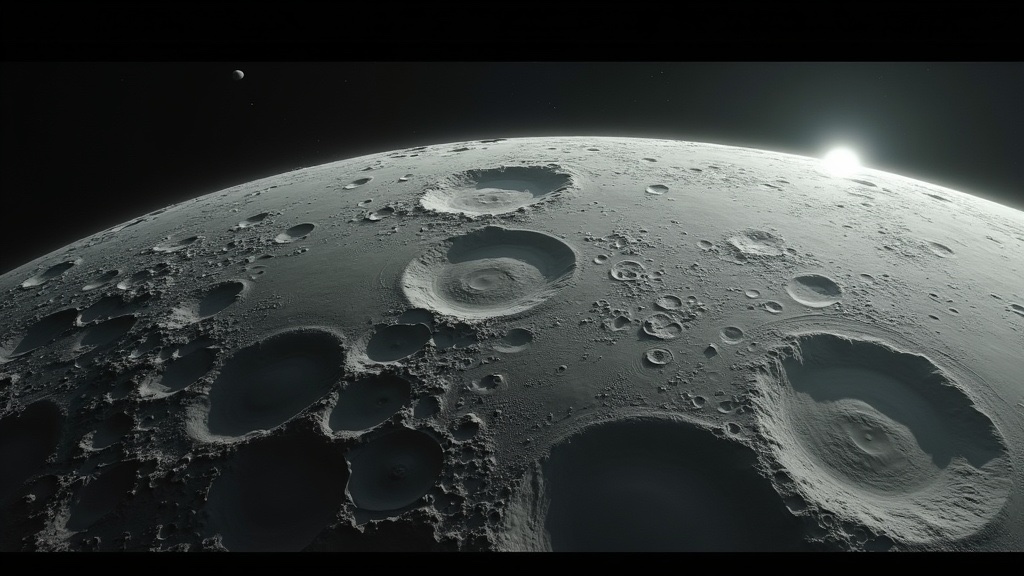
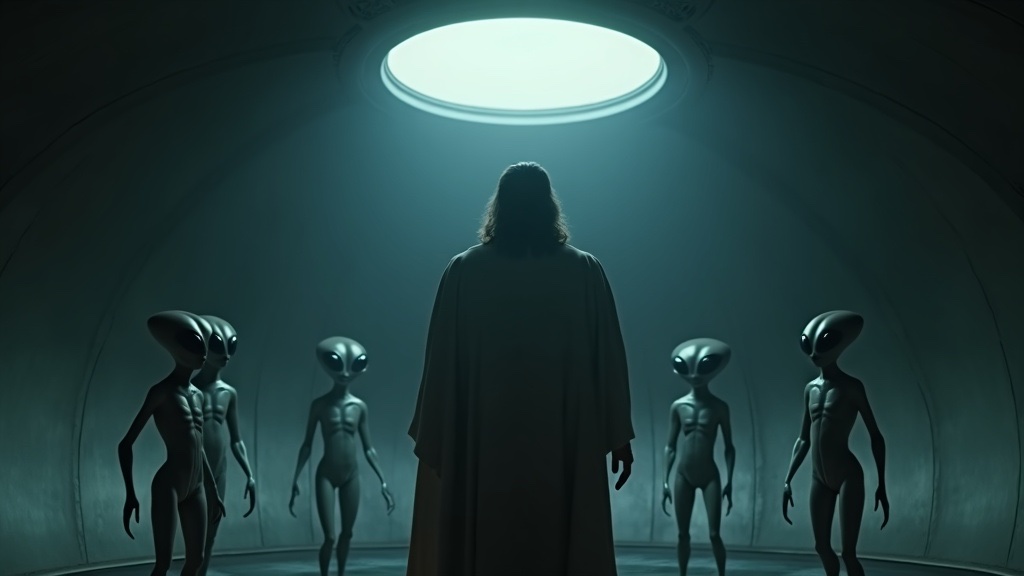
AI-generated illustration · the far side of the Moon
You have almost certainly seen the towers. A still from a NASA orbiter, a crater floor raked by low light, and there it is: a spire, a wall, a shape too straight to be an accident. The caption says they don't want you to see this. And for a moment, looking at it, you believe.
The caption invites a yes or a no. There is a better question. Take everything — the viral stills, the declassified paperwork, six decades of instrument data — and run it through one archive that grades every claim the same way. What survives sorts into three layers, and the layers are nothing alike. Most arguments about the Moon come down to someone confusing one for another.
How we grade lunar claims — from one blurry photo to named astronautsCLICK TO ENLARGE ⤢
From weakest to strongest: the "structures", which are photographs read by software; the anomalies, which are measurements NASA's own instruments made and has never fully explained; and the astronauts, who came home describing things they could not identify. We take them in that order. And a note before we start, because it colours all three: NASA is a superb builder of instruments and a poor candidate for a neutral referee. It is a civilian agency that has never been independent of the national-security state. It shares launch infrastructure and payloads with military and reconnaissance programmes, and the United States has since made space an official warfighting domain, a Space Force and all. So weight NASA's data very highly, because the cameras and spectrometers are real. Weight NASA's silence at close to nothing. The two are not the same thing, and most of this story lives in the gap between them.
The structures, and the man who flags them
The material that launches a thousand thumbnails traces back, in our files, largely to one researcher: Max Dirikshani. It is fashionable to wave him off as a guy who sees faces in rocks. Watch the actual interviews and that is not what is going on.
Start with why he is looking at all. The premise is not his; it is Carl Sagan's. Sagan argued, from Drake-equation reasoning, that the solar system has probably been visited many times over its history, and that a geologically dead world with almost no erosion — the Moon — is precisely where the durable evidence of such visits would still be sitting, undisturbed, for us to find. Searching the lunar surface for artefacts is, in other words, a research programme a Cornell astronomer endorsed in print, not a fringe hobby. Dirikshani is running Sagan's search with tools Sagan didn't have.
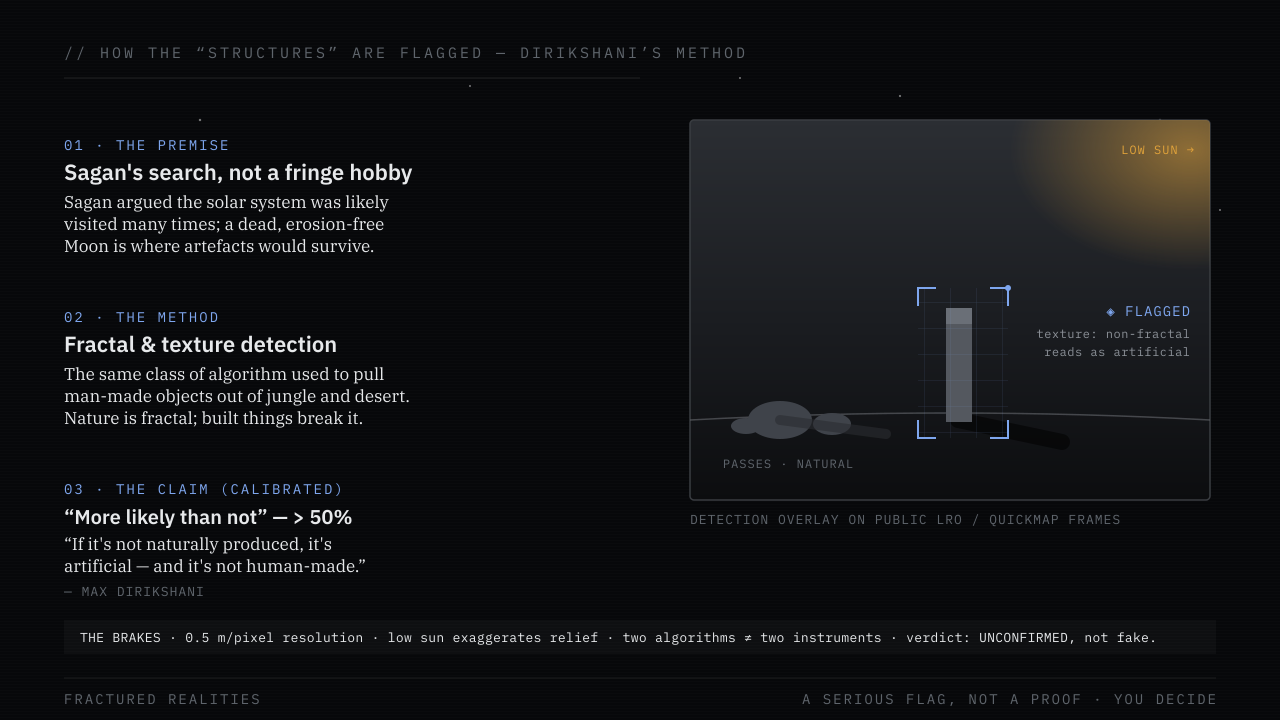
Those tools are the part the debunks skip. He does not eyeball the images. He runs fractal and texture-based anomaly-detection algorithms over them — the same family of technique that remote-sensing and defence analysts use to pull man-made objects out of jungle, desert and camouflage. The logic is old and sound: natural landscapes are statistically fractal, self-similar across scales, and human structures break that pattern, which is exactly what a detector is tuned to catch. Dirikshani overlays the algorithm's output on the lunar frames and shows that his flagged features, the spires and the rectilinear blocks, light up the way terrestrial buildings do and the way ordinary terrain does not. He is careful about the ceiling on this: not "these are alien cities", but "it is more likely than not that artificial structures exist on the Moon", and "if it's not naturally produced on the Moon, it's artificial, and it's not human-made." That is a probabilistic, falsifiable claim, and it is a good deal more disciplined than his critics grant.
How the "structures" get flagged — Dirikshani's detection methodCLICK TO ENLARGE ⤢
The catalogue is real and it is varied. At DeForest on the far side, a wishbone tower about half the height of the Eiffel Tower and a row of aligned conical peaks. At Paracelsus C, a trio of rectilinear blocks that the detectors read as artificial. At Plaskett U near the north pole, a pair of tower-like structures some ninety-five feet tall, with apparent track-like marks nearby, first noticed because that exact patch was blurred in the public QuickMap and only resolved in sharper frames later. At Eukert, a triangular platform and a cylinder casting an arm-like shadow, and this one sits in a real Apollo 17 mapping-camera frame rather than a modern orbiter mosaic. At Aristarchus, a cube-like form on the crater floor flagged by two independent detection algorithms rather than one.
The brakes matter too, and they cut real notches out of the case. LRO's best cameras resolve about half a metre per pixel, and below that scale the fine geometry the algorithm is scoring is inferred, not seen. Low sun angle — and nearly all these frames use it — stretches shadows until ordinary boulders and slumped terraces read as machined; photograph the same feature under a high sun and some of the towers relax back into rocks. And two algorithms agreeing is not two instruments agreeing; a detector re-run on the same pixels can share the same blind spot. A blurred patch in a public mosaic is usually a routine tiling seam, not a cover-up.
Put the two halves together and you do not get "fake". You get unconfirmed, and under-investigated. This is a methodologically serious flag, an established technique applied to NASA's own imagery and returning a consistent "reads as artificial" signal, that has not yet been closed by the one thing that would close it: high-resolution, high-sun-angle, independently-tasked follow-up on the specific coordinates. That follow-up is cheap and nobody with the cameras has run it. The towers have not been debunked. They have been ignored, which is not the same verdict, and the difference is the whole point.
For the record, there is no classic black monolith in our files; what Dirikshani has are towers, spires and cylinders. But even the monolith won't quite die, and it has picked up a source that changes its weight; more on that below.
Then it gets real
One rung up, the material stops being photographs and becomes measurements: the anomalies NASA's own hardware recorded and could not explain. Weight these more heavily than the imagery, not because NASA is trustworthy, but because a spectrometer reading is not a judgement call the way a shadow is.
The far side first, and a patch called Compton–Belkovich.
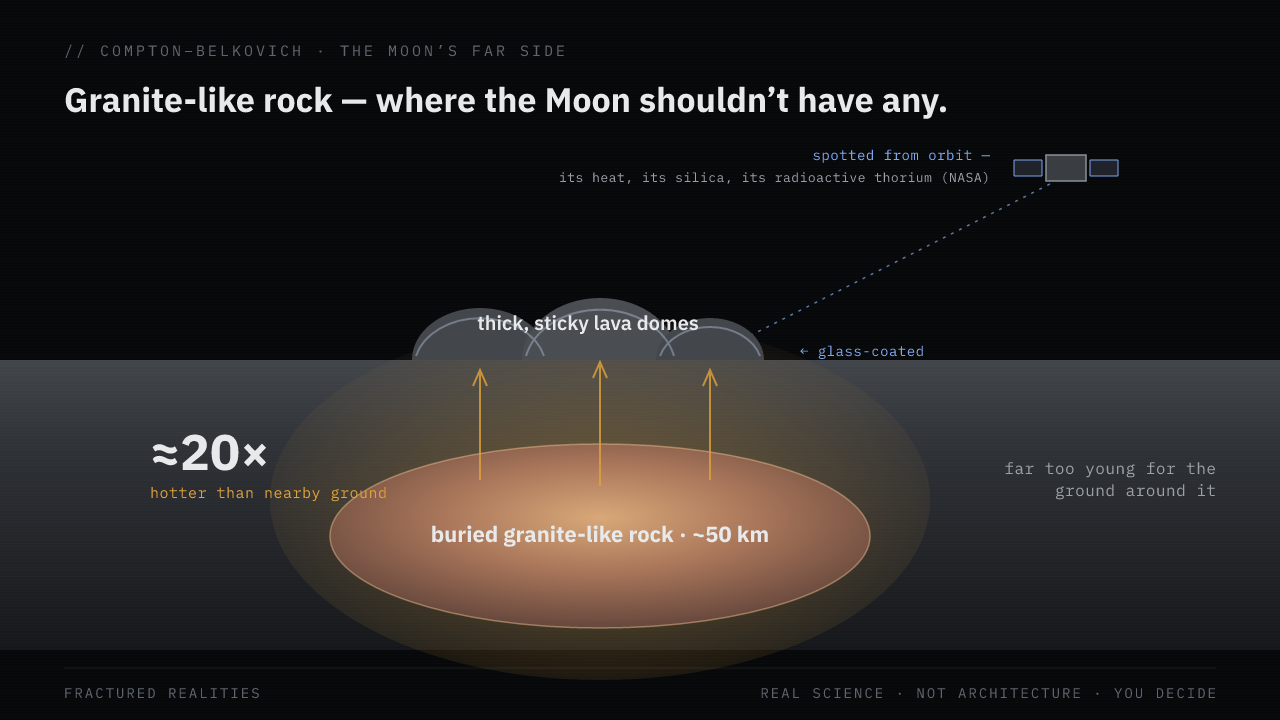
Granite-like rock, where the Moon shouldn't have anyCLICK TO ENLARGE ⤢
On Earth, granite needs water and plate tectonics to form. The Moon has neither. Yet one far-side region is built from silica-rich, granite-like rock: a buried mass roughly fifty kilometres across, radiating about twenty times the heat of the ground around it, glass-coated, and far younger than the three-billion-year terrain it sits in. The thorium hot-spot was caught by Lunar Prospector's gamma-ray spectrometer in 1998, the silica confirmed by LRO's Diviner instrument, the whole thing written up in Nature Geoscience in 2011. NASA's read is volcanic, not artificial — a hidden granitic system its own models did not predict. Even the boring answer amounts to "there is something on the far side that should not be there". No aliens required, and it is still one of the strangest places in the solar system.
Then Aristarchus, the brightest crater on the Moon and, tellingly, one we never visited; the Apollo flight that would have gone there was cancelled.
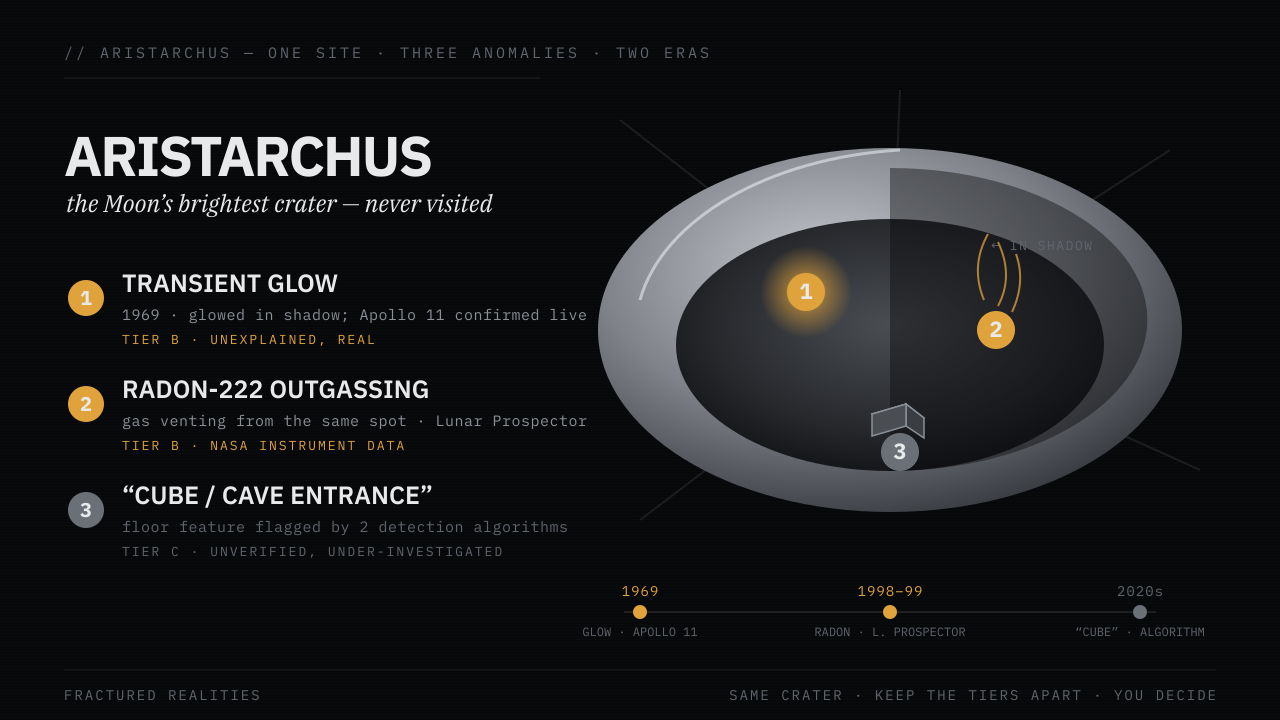
One crater, three anomalies, across sixty yearsCLICK TO ENLARGE ⤢
Astronomers have logged transient glows there for centuries. On 19 July 1969 German observers reported it brightening, NASA radioed the Apollo 11 crew to look, and the crew confirmed a glow while the crater sat in shadow. Decades later, Lunar Prospector detected radon gas venting from the same spot. And in our own decade the detectors found their cube on its floor. One crater, three claims of three strengths: a glow astronauts confirmed live, a gas leak an orbiter measured, and a photograph that may be nothing — the same location lighting up across three eras and three instruments.
The horizon glow follows the same pattern.
After sunset, the Moon's horizon glows — and NASA can't fully say whyCLICK TO ENLARGE ⤢
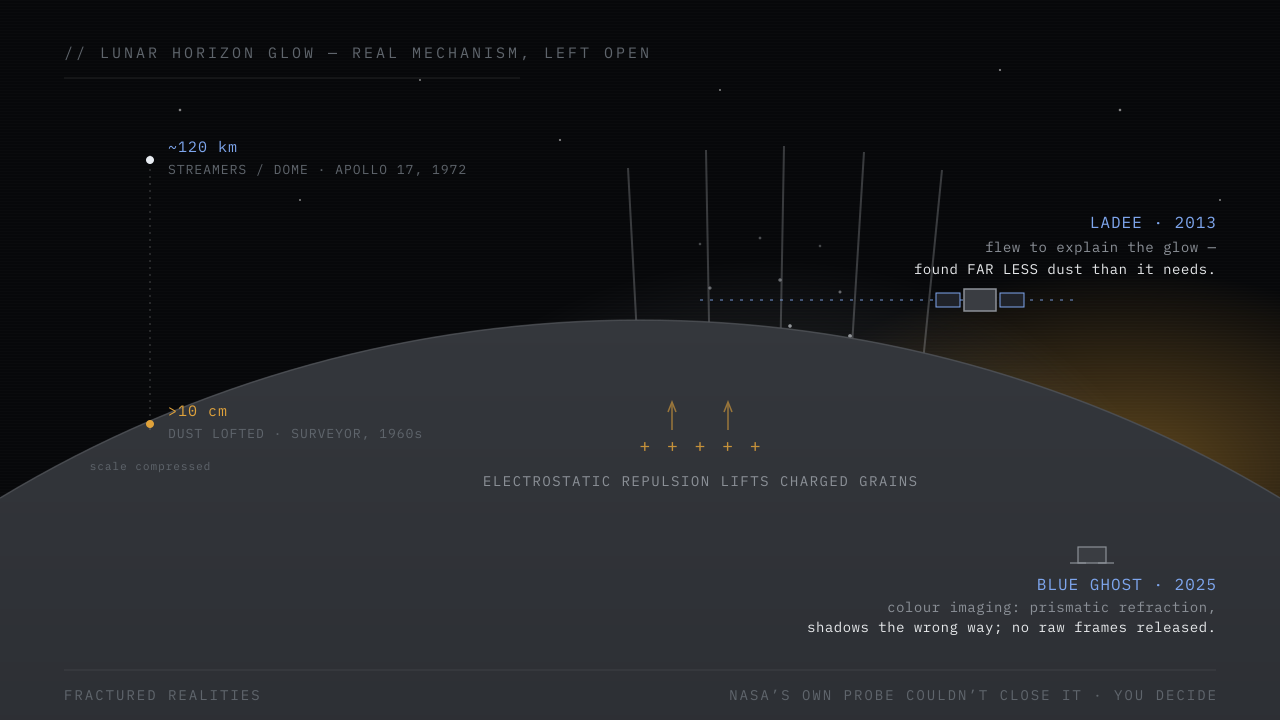
After sunset a faint glow rises off the Moon's horizon; the Surveyor probes photographed it in the 1960s and the Apollo 17 crew sketched it, streamers reaching improbably high. The tidy explanation is electrostatic, charged dust lofted off the surface and catching sunlight. Except NASA flew a whole mission, LADEE, to confirm it, and LADEE found far too little levitated dust to produce what people keep seeing. An anomaly found by NASA instruments that other NASA instruments then failed to close.
The impact flashes used to be the tidiest open case.
A flash with no shakeCLICK TO ENLARGE ⤢
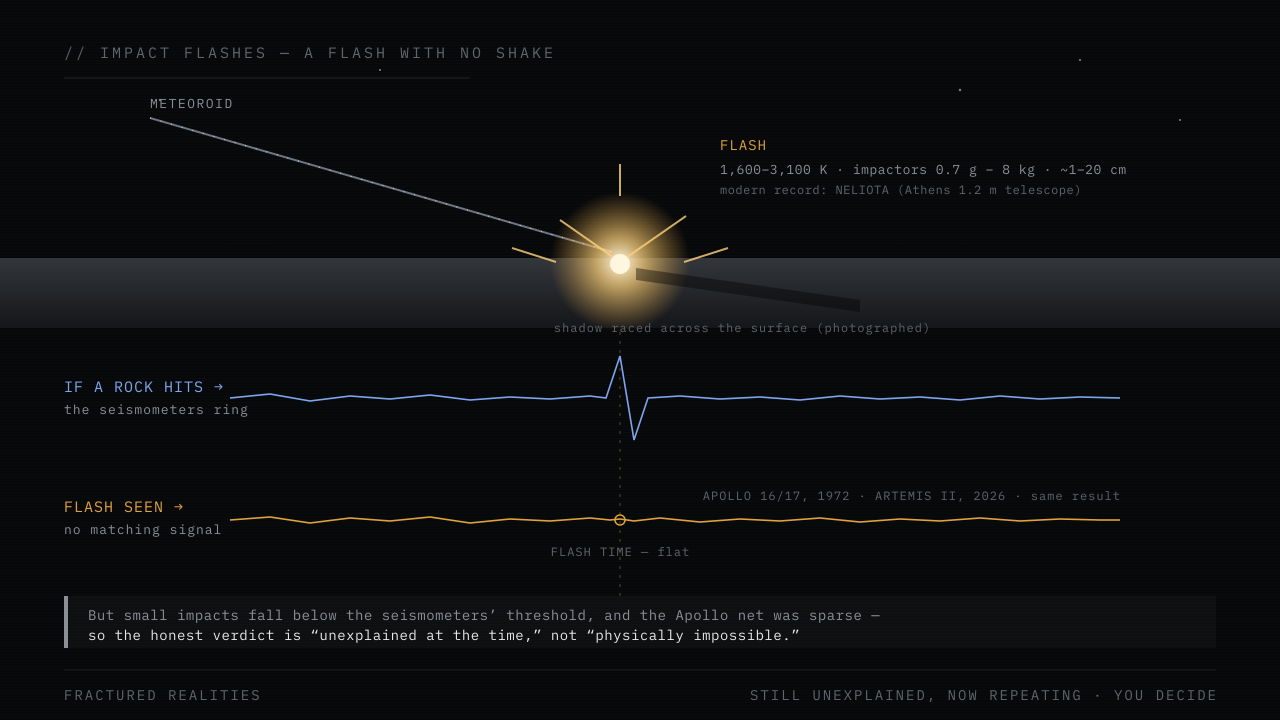
Astronauts on Apollo 16 and 17 kept reporting flashes on the surface. When a rock hits the Moon the seismometers should ring, and for some flashes there is no matching seismic signal at all; a modern NASA paper confirms flashes with no detected impact behind them. The fair caveat has always been that small impacts fall below the seismometers' threshold and the Apollo network was sparse.
Here is what changed. On its close pass this year, the crew of Artemis II reported the same things — four impact flashes attributed to asteroids, again with no seismic confirmation, and, during an eclipse, an anomalous glow wrapped around the entire Moon some ten sun-diameters wide, with refractive streamers and a rainbow reaching into the shadow. New crew, new instruments, more than fifty years on, and the two oldest open anomalies in the file resurfaced almost unchanged. That is the one thing every other claim in this file lacks: the same anomaly, reported again, by people and instruments that owe nothing to the first report. It proves nothing artificial. It does move the flashes and the glow out of "an odd thing some Apollo guys once said" and into "a thing that keeps happening whenever a human gets close enough to look".
The men who went
The top of the ladder is not a photograph or a graph. It is testimony, from the small pool of people who have actually been out there.
The watched missions — astronauts on the recordCLICK TO ENLARGE ⤢
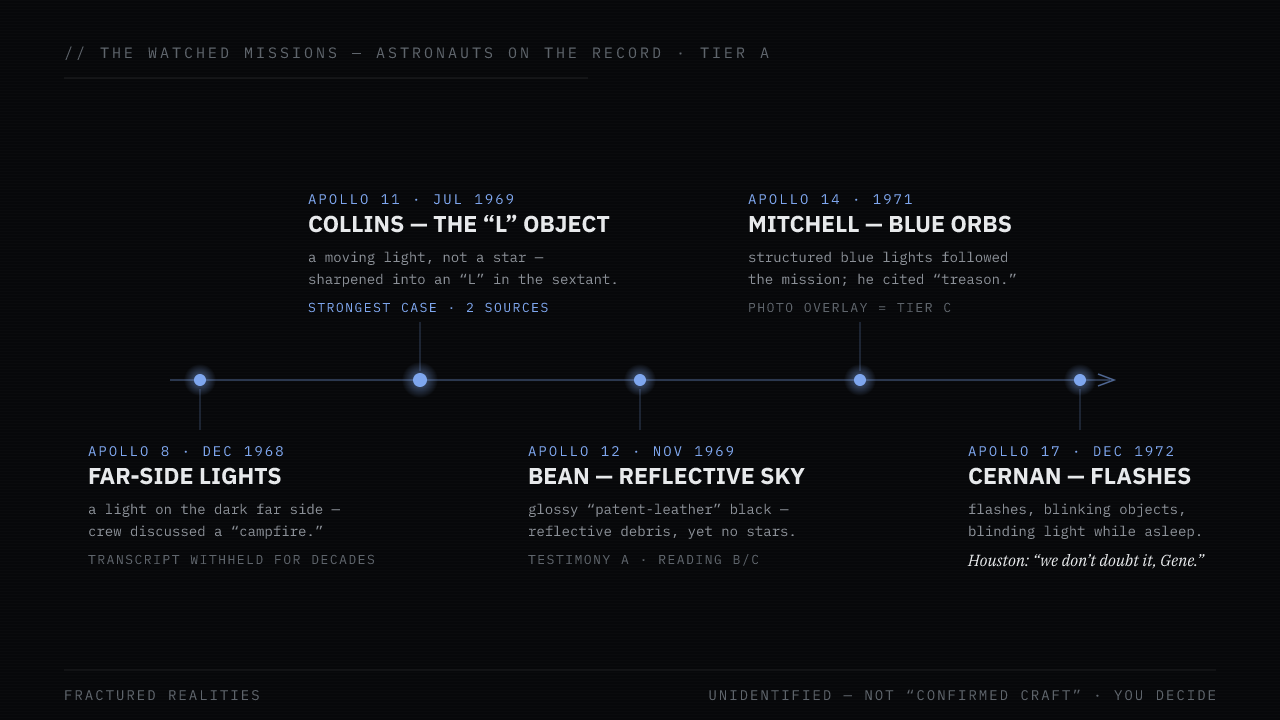
On Apollo 11, Michael Collins tracked a moving light that was not a star; through the telescope it sharpened into an "L". Rather than say aloud what they were watching, the crew asked Houston how far away the jettisoned booster was, heard the answer, and dropped the subject. On Apollo 12, Alan Bean kept describing a sky like patent leather, glossy black with reflective debris in it, though he could see no stars. Edgar Mitchell said blue, structured lights followed Apollo 14, and that he kept it to himself for years because going public was — in his words — like "treason". On Apollo 17, Gene Cernan reported flashes and blinking objects, and Mission Control's reply is preserved on the loop: "we don't doubt it, Gene."
Two caveats stay pinned here. Every one is an unidentified observation, not a confirmed craft; Collins saw a light he could not place, not a saucer. And this is the tier the internet most loves to salt with hearsay — the "Apollo 8 saucer with portals", the they-told-us-to-leave line attributed to Armstrong, which our own data marks apocryphal. Dragging that in only discredits the men who went on the record. Keep the named astronauts clean.
"…but is NASA hiding it?"
Given the framing at the top, the fair answer is: of course it holds some things back, that is what it is built to do, and that fact proves far less than either side wants.
The concrete threads are real. Plaskett U was blurred in the public map before sharper frames surfaced. The Apollo 8 crew discussed a light on the dark far side as a "campfire" in a transcript that stayed unreleased for decades. When Firefly's Blue Ghost lander imaged the horizon glow in colour in 2025 — prismatic refraction, shadows pointing the wrong way — the company confirmed no floodlights were used and no raw imagery was ever downlinked. There is a real programme, Project Moon Dust, under which the US Air Force quietly recovered fallen objects of unknown origin for years. And the withholding now has a name attached at the top: Lue Elizondo, formerly of the Pentagon's UAP programme, says flatly, "There are also photographs that I don't believe have been made public yet that show, on the lunar surface, what appear to be large monolithic structures with right-angle cuts." That is the monolith the imagery lacks, asserted to exist in files we are not allowed to see, by a person with the clearances to know. There is no way to check him — which is the trap, and the reason to quote it at its own strength: a specific, unverifiable claim from a credible source, no heavier and no lighter than that.
The mundane deserves its say too, and it wins most rounds. A blurred mosaic tile is usually just a mosaic tile. Downlink triage on a short-lived lander is ordinary engineering. And released files are a curated fraction of what exists — which means a withheld transcript is worth noting and is weak evidence of any specific thing, because absence from the public record proves nothing either way. NASA is not honest and it is not lying; it is an institution with national-security entanglements doing what such institutions do. "Held back" is not "proof". Both are true at once.
Why the Moon — and why now
If you were going to put something on the Moon, the sensible place is not a crater floor. It is underground, and here the boring truth outruns the hype.
There's a confirmed cave under the Sea of TranquilityCLICK TO ENLARGE ⤢
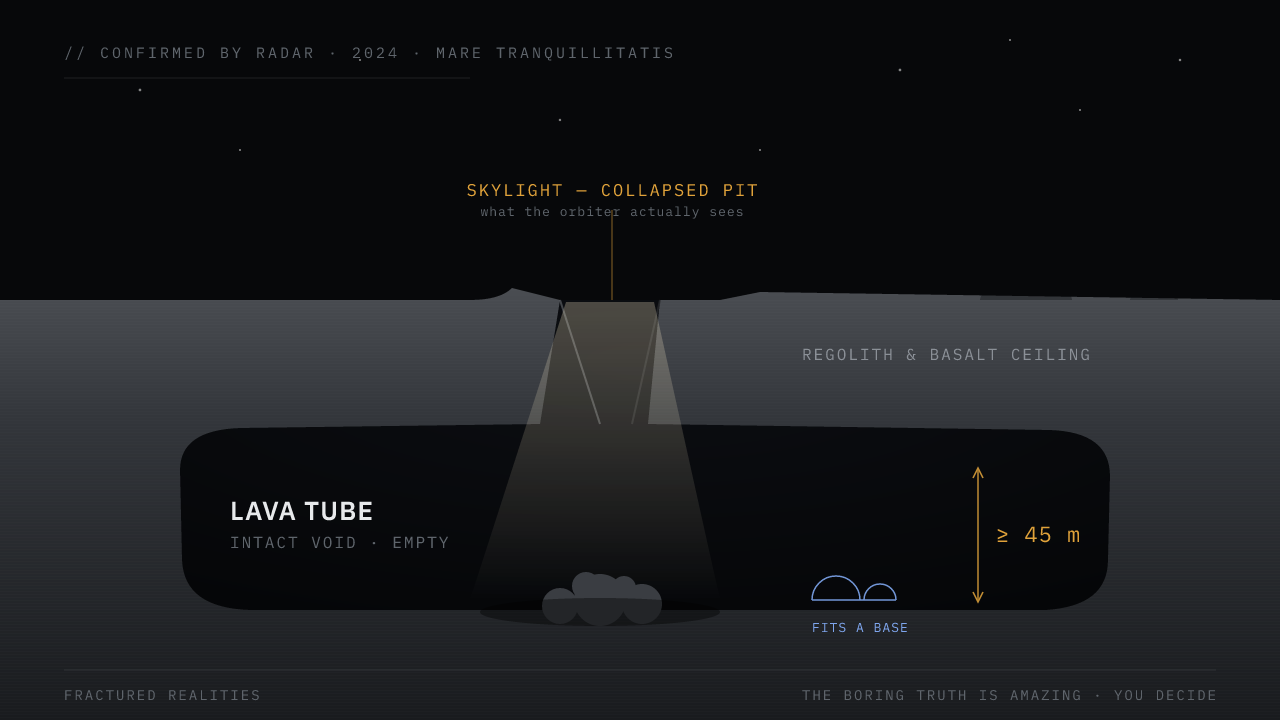
Gravity mapping and radar have found more than two hundred pits and skylights opening into subsurface voids, including a lava tube on the order of sixty kilometres long. In 2024 reprocessed radar confirmed an accessible cave under the Mare Tranquillitatis pit: at least forty-five metres wide, empty, shielded from radiation and from the temperature swings that make the surface brutal, and now a leading candidate for the first human base. So there really are city-scale caves down there. There is nobody on record living in them.
The idea that someone already is turns out to be old. In the 1950s the investigator Donald Keyhoe wrote that "it is not impossible that a race from some other planet could already have set up… an operating base" up there, and an official named Norman G. Markham allowed that "the Moon is either inhabited or in use by other than human beings." Modern versions are more credentialed and no more provable. The plasma physicist John Brandenburg claims the 1994 Clementine mission was in effect reconnaissance, "to check out if someone was building bases on the Moon". Elizondo, more careful than any promoter: "There are classified sources… that indicate that the Moon is or was perhaps of particular interest by something or someone other than us." Beyond that is pure mythos — remote viewers supposedly surveying the surface before the landings, a "we can split the Moon in half" boast that reaches us through three layers of hearsay. Good campfire material. Not evidence.
The reason the question feels current is the traffic. Artemis, commercial landers like Blue Ghost, China's far-side programme, the scramble for polar ice: the Moon is entering a land-rush, and one industry figure put the stakes bluntly — "the countries and companies that control the Moon will eventually control the Earth." All those new cameras change the problem, because for the first time the claims become testable by redundancy. Artemis II already did it once, resurfacing the flashes and the glow. Point the same redundancy at Dirikshani's coordinates — high sun, high resolution, a camera he doesn't own — and the towers finally get their fair test. That test has not been run. It should be.
The honest floor
Strip everything down to what survives and it is smaller than a believer wants and larger than a debunker will admit.
There is no proof that anyone built anything on the Moon. But "no proof" is not "no case", and the case is stronger than the usual shrug allows: a real detection methodology, Sagan's own premise, and a catalogue of features that read as artificial and have simply never been re-imaged properly. Above that sits the harder currency — a crater glow Apollo 11 confirmed live, a horizon glow NASA's own probe could not account for, impact flashes with no seismic echo logged by Apollo and again by Artemis II, granite on a world that cannot make granite, and the most scrutinised humans alive reporting lights they could not name. Keep the software layer and the instrument layer cleanly separate and the story is both gripping and true.
The sceptic gets the heavy word, because voicing him well is what earns the rest. J. Allen Hynek — the astronomer who spent twenty years explaining away other people's UFOs for the US Air Force, and who did not spook easily — built a career on how a balloon, a bright planet or a re-entering booster becomes, in an honest witness's memory, a structured craft. Some of these lunar wonders die on exactly that rock. But not all of them, and the ones that don't are not getting the follow-up their own evidence has earned — from an agency whose data we trust and whose silence we shouldn't. The next wave of landers is about to settle which is which. The only real scandal would be not looking.
Reports, not reality. We index the claims; we don't assert them.