// OPEN INTELLIGENCE — PUBLIC ARCHIVECASE FILE · THE RECORD
FRFRFR
← THE ARCHIVE
◆ CASE FILEThe facts, corroborated

Balloon-Shaped Radar Targets over the DMZ

From the start of 1970 South Korean Air Force radar stations on the east coast tracked large balloon-shaped objects manoeuvring at high altitude just north of the DMZ, a US Army intelligence report says. Several crossed into South Korean airspace, flew south-east over Kangwon-do and exploded, and searches for debris came up empty. This is the record of what the report says radar tracked, not a verdict on what crossed the border.

◆ THE SHORT VERSION

  • Balloon-Shaped Radar Targets over the DMZ is a reported UAP case in East coast of Kangwon-do, South Korea, and just north of the eastern end of the DMZ, January-February 1970.
  • A US Army intelligence report says South Korean Air Force radar stations tracked large balloon-shaped objects manoeuvring at high altitude just north of the eastern DMZ from the start of 1970.
  • On several occasions, the report says, the objects crossed into South Korean airspace, flew south-east over Kangwon-do and exploded, and searches found no debris.
  • The ROKAF Chief of Staff speculated that North Korea might use such self-propelled balloons to drop agents, propaganda or even epidemic germs.
  • The account reached the Americans second-hand, through a briefing and a South Korean intelligence source the report rates C-6.
  • For this case Fractured Realities holds 1 distinct source, 1 corroborating primary document and 1 claimant on its resolved list.
  • The archive grades it L4 · OFFICIAL RECORD — a released government record names who saw it, the top of our scale, though no independent testimony sits beside that record.

Counts are resolved totals of what sources say, computed 2026-10-03; the reported details above are claims in the record, not findings. A record of reports, not a verdict on what happened.
Balloon-Shaped Radar Targets over the DMZ
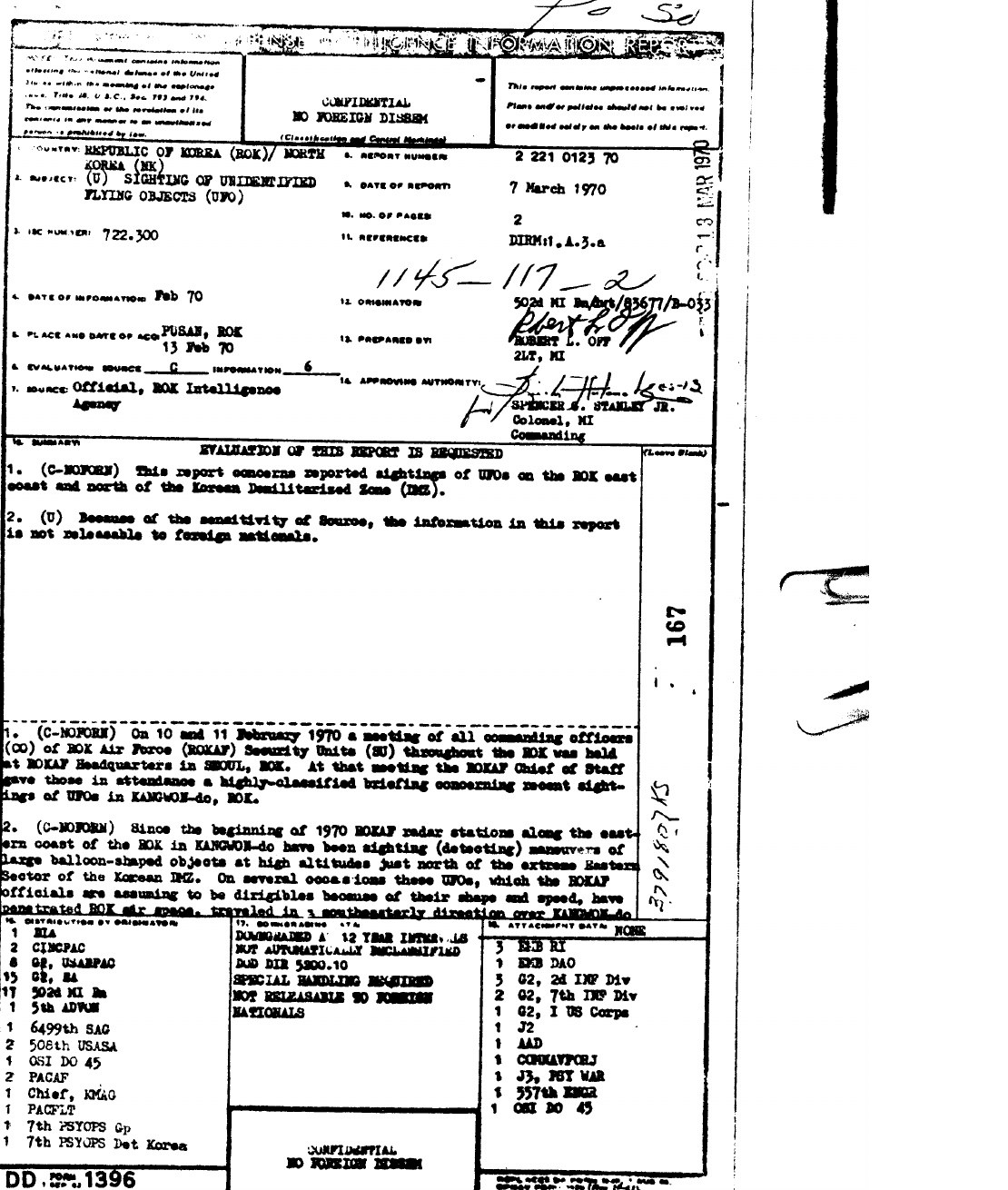
From the case file · released government record · CIA reading room document CIA-RDP81R00560R000100070026-7, p. 1 · US Army intelligence information report on ROKAF radar sightings of UFOs north of the DMZ, 7 Mar 1970 · released by the CIA under FOIA ↗
EVENT DATE
January-February 1970
LOCATION
East coast of Kangwon-do, South Korea, and just north of the eastern end of the DMZ · South Korea
COORDS
38.50°N 128.38°E
INDEPENDENCE
L4 · OFFICIAL RECORD
SOURCES
1 distinct
CLAIMANTS
1
STATUS
Known from released government records
NUMBERS COMPUTED 2026-10-03 · RESOLVED COUNTS, NOT A VERDICT

VIEW ON ATLAS →

The objects came over the border and blew up. Since the beginning of 1970, a US Army intelligence report says, Republic of Korea Air Force radar stations along the east coast of Kangwon-do had been "sighting (detecting) maneuvers of large balloon-shaped objects at high altitudes just north of the extreme Eastern Sector of the Korean DMZ". On several occasions these UFOs "penetrated ROK air space, traveled in a southeasterly direction over KANGWON-do and then exploded". South Korean efforts to recover debris after the explosions failed. ROKAF officials assumed the objects were dirigibles "because of their shape and speed".

What is on the record

The archive holds a US Army Intelligence Information Report, number 2 221 0123 70, headed "Sighting of Unidentified Flying Objects (UFO)" and dated 7 March 1970. The 502d Military Intelligence Battalion filed it. It was classified Confidential with no foreign release. Copies went to the DIA, the Pacific commands and the Air Force's investigators, and it later came out through the CIA's reading room. It is a primary intelligence record, not a press translation.

It is also second-hand. On 10 and 11 February 1970 the ROKAF Chief of Staff gave the commanders of the air force's security units "a highly-classified briefing" in Seoul on the sightings. A medium-level member of a South Korean intelligence agency in Pusan passed the substance to the Americans. The report grades it C-6, a fairly reliable source whose information cannot be judged true or false. The Chief of Staff speculated that if the current manoeuvres proved successful, North Korea might use "self-propelled balloons" to drop agents, propaganda or "even epidemic germs" into the South. His briefing, the report says, caused consternation among the commanders, who had heard of no such penetrations before. No outside account of the episode has been found.

Why it sits where it does

The page grades L4 · OFFICIAL RECORD — a released government record names who saw it. Here the observers are the South Korean air force's east-coast radar stations, reported at second hand through a briefing and an informant. No independent testimony sits beside the record in the archive. The tier measures sourcing, never truth. What the radars tracked north of the DMZ is not resolved here.

◆ CORROBORATION
✓CIA FOIA document cia rdp81r00560r000100070026 7 (government primary)
◆ SOURCES

Everything this file draws on, in the open — reports, not reality. Check us.

Documents & published sources

Government records, papers and journalism the archive links to this case.

government record · 1
RADARMILITARY INCIDENT1970SOUTH KOREA

CASE FILES STATE THE RECORD AS OUR ARCHIVE HOLDS IT — FACTS, NOT OPINION. REPORTS, NOT REALITY.

◆ CONTINUE READING
Balloon-Shaped Radar Targets over the DMZ — Case File · Fractured Realities