// OPEN INTELLIGENCE — PUBLIC ARCHIVECASE FILE · THE RECORD
FRFRFR
← THE ARCHIVE
◆ CASE FILEThe facts, corroborated

The Metal Disc in the Pokhara Crater

On the night of 25 March 1968 a blazing object broke up over Nepal's Kaski region with a thunderclap. A huge metallic disc with a six-foot base was then found in a crater near Pokhara, a CIA information report says. The US Embassy later suggested Soviet rocket debris, though an American team in Nepal could not settle the country of origin. This is the record of what the report says fell, not a verdict on what it was.

◆ THE SHORT VERSION

  • The Metal Disc in the Pokhara Crater is a reported UAP case in Baltichaur (Batulechaur), Pokhara, Kaski district; fragments also at Talakot and Turepasal, Nepal, 25 March 1968, about 20:15 local time.
  • A CIA information report says a huge metallic disc-shaped object with a six-foot base, four feet high, was found in a crater five miles from Pokhara after a blazing object broke up over Nepal's Kaski region.
  • The object, the report says, flashed intermittently and disintegrated with a big thunder sound on 25 March 1968; portions of a similar object turned up at Talakot and Turepasal.
  • State Department papers say an American team examined the fragments in Nepal and could not determine their country of origin.
  • The US Embassy suggested in August 1968 that the object could be Soviet, possibly from the rocket that carried Kosmos 208, according to the Nepali Times.
  • For this case Fractured Realities holds 1 distinct source and 1 corroborating primary document.
  • The archive grades it L0 · SINGLE ACCOUNT — the archive holds one account of it, from a single source.

Counts are resolved totals of what sources say, computed 2026-10-03; the reported details above are claims in the record, not findings. A record of reports, not a verdict on what happened.
The Metal Disc in the Pokhara Crater
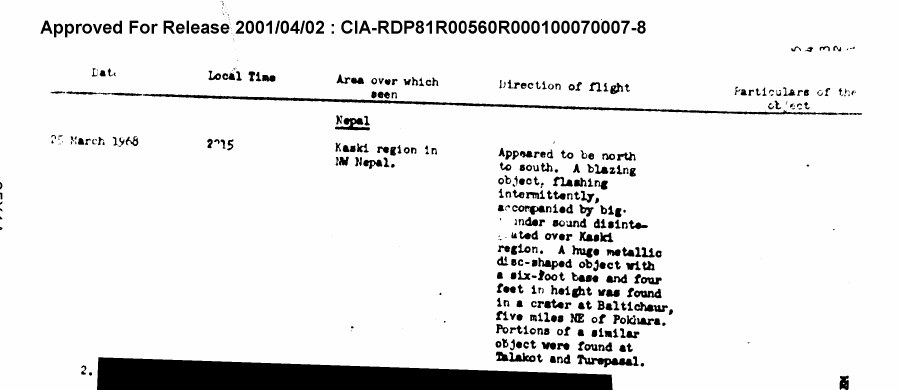
From the case file · released government record · CIA reading room document CIA-RDP81R00560R000100070007-8, p. 6 · the Nepal entry for 25 March 1968 in a CIA information report on bright objects over the Himalaya, 11 Apr 1968 · released by the CIA under FOIA ↗
EVENT DATE
25 March 1968, about 20:15 local time
LOCATION
Baltichaur (Batulechaur), Pokhara, Kaski district; fragments also at Talakot and Turepasal · Nepal
COORDS
28.21°N 83.99°E
INDEPENDENCE
L0 · SINGLE ACCOUNT
SOURCES
1 distinct
CLAIMANTS
0
STATUS
Known from released government records
NUMBERS COMPUTED 2026-10-03 · RESOLVED COUNTS, NOT A VERDICT

VIEW ON ATLAS →

The object came in from the north flashing on and off and blew apart with a sound like thunder. A CIA information report distributed on 11 April 1968 gives it a single table row. The date is 25 March 1968 and the local time has one smudged digit; later press accounts say 8.15 in the evening. The entry reads: "a blazing object, flashing intermittently, accompanied by big thunder sound disintegrated over Kaski region". Then comes the find: "A huge metallic disc-shaped object with a six-foot base and four feet in height was found in a crater at Baltichaur, five miles NE of Pokhara." Portions of a similar object were found at Talakot and Turepasal.

What is on the record

The archive holds that report, CIA-RDP81R00560R000100070007-8. It is the CIA's own field reporting, classified Confidential and barred from foreign release. It tabulates bright objects seen over Ladakh, north-east Nepal, Sikkim and western Bhutan in February and March 1968. The Kaski entry is one row. The subject line and source are blacked out. A 1974 index printout from the Air Force's Foreign Technology Division is filed with it and some press stories give the report that date.

Others have followed the fragment further. The National Security Archive has published State Department papers on "unidentified fragments that fell in Nepal and which were not claimed by any country". Nepal let an American team examine them. The team "could not determine the country of origin" there. In 2024 the Nepali Times traced the find to a farmer's field near Batulechaur on Pokhara's northern edge. Villagers there remember a metal sheet about two metres by one. The paper reports that the US Embassy told Washington in August 1968 the object could be Soviet and possibly from the rocket that carried Kosmos 208. No one knows where the sheet is now, it says.

Why it sits where it does

The page grades L0 · SINGLE ACCOUNT. A primary government record carries it but names no witness. The villagers are named only in journalism, which does not raise the tier. The tier measures sourcing, never truth. What came down over Kaski is not resolved here.

◆ CORROBORATION
✓CIA FOIA document cia rdp81r00560r000100070007 8 (government primary)
◆ SOURCES

Everything this file draws on, in the open — reports, not reality. Check us.

Documents & published sources

Government records, papers and journalism the archive links to this case.

government record · 1
FIREBALLSPACE DEBRIS1968NEPAL

CASE FILES STATE THE RECORD AS OUR ARCHIVE HOLDS IT — FACTS, NOT OPINION. REPORTS, NOT REALITY.

◆ CONTINUE READING
The Metal Disc in the Pokhara Crater — Case File · Fractured Realities